Succession Planning: The Unreplicable Competitive Advantage in a Volatile Era
Strategy can pivot, business models can adjust, and technology can be replaced, but if an organization lacks capable, suitable, and ready individuals to lead the next phase, any competitive advantage can become fragile.
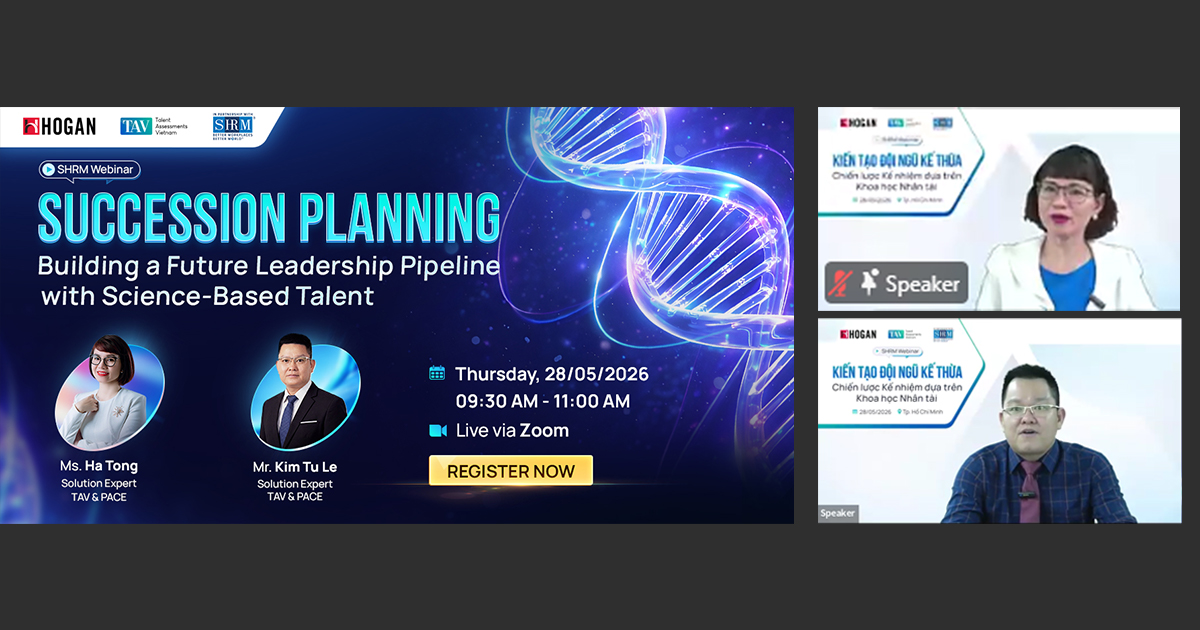
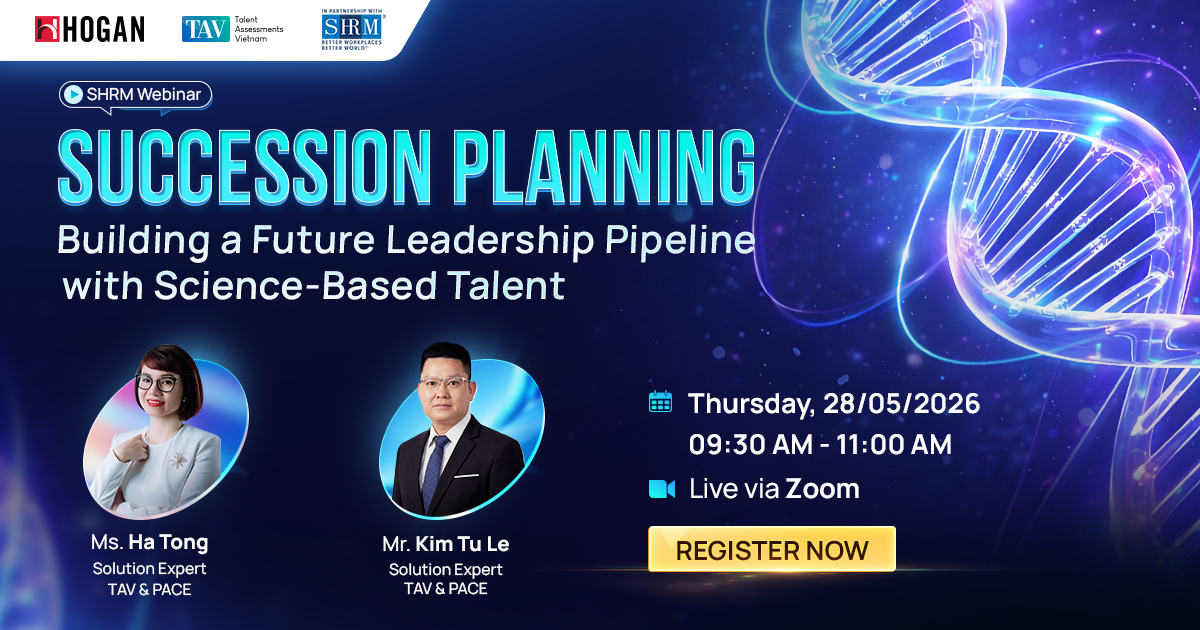
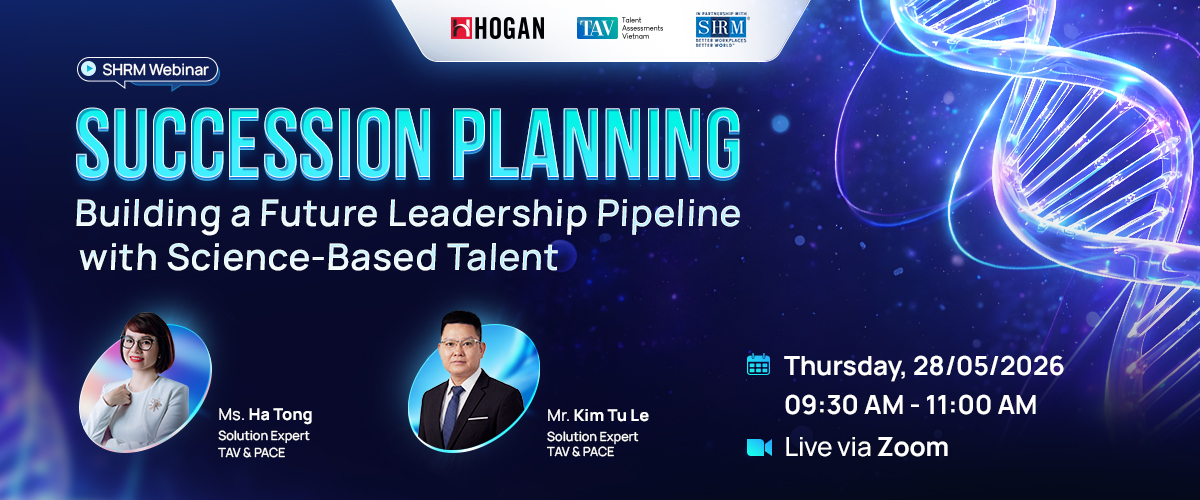
This was the core message of the seminar "Building a Succession Team: A Succession Strategy Based on Talent Science," co-organized by SHRM Vietnam, Hogan Assessments, and Talent Assessments Vietnam. The event featured professional insights from Ms. Tong Thi Nhi Ha and Mr. Le Kim Tu, Solution Experts at PACE & TAV, alongside practical perspectives from Ms. Phan Thi Khoa, a seasoned expert in L&D and leadership development at large enterprises.
The event attracted over 300 HR professionals, specialists, managers, and business leaders, all seeking scientific solutions for the future of their organizations.
Why Has Succession Moved Beyond a Simple Backup Plan?
Opening the seminar, Mr. Le Kim Tu guided attendees through a famous Greek story about three stonemasons. When asked what they were doing, the first said he was stacking stones to make a living. The second said he was building a wall. The third replied that he was building a temple that would last through the ages, even long after he was gone.
This story offers a perspective deeply relevant to business leadership. A good leader delivers current results. A great leader develops people who can continue to guide the organization long after they have left their position. Therefore, succession is not merely about preparing people for potential vacancies; it is a metric of an organization's capacity to nurture the next generation of leaders.
In many organizations today, succession planning has been integrated into talent management processes, but it often stops at reviewing lists and identifying high-potential employees for key roles. While this is a necessary starting point, it is not enough to ensure leadership readiness.
From this viewpoint, the speaker posed a highly practical question to the audience: If a key leadership position suddenly became vacant in the next 6 months, does the organization already have someone with the necessary capability and readiness to take over the role?
According to Ms. Nhi Ha, a proper succession plan must begin with the right context. Before building a succession plan, a business needs to evaluate its current stage in the organizational lifecycle. Is the company in the startup, growth, maturity, or decline phase? Each stage demands a different type of leadership capability. A leader who succeeded during a growth phase - prioritizing market expansion and sales increases - might not be suitable when the business enters a phase of maturity, restructuring, or transformation.
Furthermore, businesses must deeply understand their direct competitors. In today's business environment, companies compete on products, services, customer experience, and human resource quality. If HR and leadership do not grasp the competitive context, the ideal successor profile can easily be shaped by internal bias rather than market demands.
Beyond strategy, organizational culture is a crucial variable. Are the current mission, vision, core values, and culture supporting the organization's strategic execution, or are they creating friction? What value system must future successors align with, and what personality traits do they need to establish a leadership style that fits the team?
3 Common Mistakes in Choosing Successors
With years of consulting and training experience in HR, Ms. Nhi Ha pointed out three common mistakes businesses make when selecting successors:
- Divorcing succession from context: When a business chooses a successor based on current achievements, seniority, or familiarity, the future leadership profile may deviate from strategic needs. An effective plan must answer: In the upcoming context, what kind of leader does the organization need to continue growing, adapting, and operating sustainably?
- Choosing the "Mini-Me": Many leaders tend to view themselves as the model of success, thereby prioritizing individuals with similar styles, thoughts, or methods. In the short term, this feels safe. In the long term, it reduces diversity within the leadership team, leaving the organization blind to new perspectives needed for new contexts. A future-ready business needs a succession team diverse in thought, capability, and style, rather than just replicating a previously successful leadership mold.
- Choosing the most prominent or currently high-performing individual: In many organizations, individuals who are articulate, confident, highly visible, and make a strong impression are often easily placed on succession lists. However, visibility does not equal leadership effectiveness, nor does stellar individual performance guarantee the potential to lead a team. A star performer might excel individually, but upon promotion to a management role, they may struggle to build trust, develop people, maintain engagement, or resolve conflicts.
From KSA to KSAO: A Comprehensive View of the Successor Profile
According to Ms. Nhi Ha, the traditional approach evaluates capability through three elements: Knowledge, Skill, and Attitude. However, in the context of leadership development and succession, the KSAO model provides a much more comprehensive view.
- Knowledge: The information an individual possesses.
- Skill: The proficiencies they can apply at work.
- Ability: The capacity to produce specific outcomes using knowledge and skills.
- Other Characteristics (O): This crucial expansion includes personality traits, motivations, behavioral styles, adaptability, cultural fit, and the leadership style the individual tends to create.
She emphasized that businesses must move beyond standard questions like "What does this person know?" or "What can this person do?" The deeper questions are: "How will this person lead when placed in a new context, under new pressures, and facing new expectations? Do they have the drive to go further, or are they only suited for their current role? How do they shape team culture? How will they react under stress? Can they build trust and maintain a high-performing team?"
By evaluating successors through the KSAO lens, businesses can better distinguish between current performance and future leadership potential. This also forms the foundation for designing personalized development plans rather than applying a one-size-fits-all training program.
7 Components of an Effective Succession Plan
An effective succession plan requires far more than just a list of candidates. The essential components include:
- Clear support from senior leadership: HR can design the framework, coordinate the process, and provide tools, but succession will fail without the active participation of the CEO, the executive board, and department heads.
- Clear leadership criteria: Businesses must define the future leadership profile based on strategy, culture, specific job groups, and role requirements. Vague criteria lead to subjective evaluations.
- Specific development plans for each successor: Following evaluation, each individual needs a tailored development roadmap detailing competencies to strengthen, experiences to acquire, behaviors to change, and measurable goals.
- A clear implementation process: Define who does what, by when, and what the expected outputs are. A succession plan without ownership, timelines, and tracking mechanisms is merely an idea.
- Connection to organizational culture: The succession plan must reinforce the values the organization wishes to maintain and develop.
- Prioritizing leadership capability over technical expertise: Expertise makes an individual successful in their current role, but leadership requires the added ability to influence, coach, delegate, manage performance, and guide people.
- Viewing succession as a strategic priority: It is not a periodic administrative task. The succession plan must be a living part of the organization: regularly discussed, updated, measured, and tied to critical talent decisions.
Hogan Assessments: The Data Science of People in Succession Planning
Continuing on the topic of successor profiles, Ms. Nhi Ha introduced Hogan Assessments' approach to using personality data for talent decisions. Hogan's differentiator is its ability to help businesses look beyond the surface of experience or achievements, thereby predicting how individuals will behave, influence, and lead in various work contexts.
Hogan focuses on Reputation (how others are likely to perceive, experience, and react to a person in the workplace) rather than just Identity (how a person views themselves). For leadership roles, reputation is paramount. A leader may have great experience and technical prowess, but their effectiveness heavily relies on their ability to build trust, influence others, foster collaboration, and guide a team toward a shared goal.
The Hogan system provides insights through three layers of personality, reflected in three core reports:
- HPI (The Bright Side): Identifies everyday strengths, typical behavioral styles, and how a person tends to interact, handle tasks, and exert influence under normal conditions.
- HDS (The Dark Side): Highlights behavioral risks that may emerge under pressure, stress, or when a strength is overused. In succession, this data is vital because senior leadership inherently involves stress, conflicting interests, high expectations, and difficult decisions.
- MVPI (The Inside): Clarifies an individual's core motives, values, preferences, and cultural fit. This predicts the type of team culture they tend to create when in a leadership position.
A key point emphasized during the seminar was that Hogan scores should not be interpreted as absolutely "good" or "bad." All results must be read within the specific context of the job, strategy, team, and culture. The value of the assessment lies in generating accurate insights to support developmental decisions, not in labeling people.
Practical Perspectives: Insights from Central Retail Vietnam
Ms. Phan Thi Khoa brought practical insights to the program, sharing her experiences in deploying talent development programs and utilizing Hogan Assessments at Central Retail Vietnam.
According to Ms. Khoa, in an era where AI can heavily polish resumes and interview answers, businesses need assessment tools that delve deeper into a candidate's working style, motivations, and behavioral risks. Hogan Assessments help organizations reduce reliance on subjective feelings, especially in critical leadership selections.
Another key value of Hogan, she noted, is creating a common framework for dialogue among the organization, the manager, and the assessee. Instead of vague feedback about "having potential" or "needing development," parties can have specific discussions about strengths, areas for improvement, personal motivations, behavioral risks under pressure, and appropriate developmental directions.
This message is particularly profound for HR managers: Assessment only generates initial understanding; real change happens when those insights are transformed into developmental actions.
Q&A: Untying the Knots in Succession Planning
The concluding Q&A session expanded the discussion based on the real-world concerns of attending businesses:
- Identifying the organizational lifecycle stage: Experts advised looking at foundational signals like years in operation, revenue, growth/decline rates, market shifts, and strategic direction to determine what type of leadership is needed for the future.
- Contextualizing Hogan results: Assessment data should never be applied mechanically across all industries, companies, or roles. Results are only meaningful when aligned with specific job requirements and organizational culture.
- The roles of HR vs. Leadership: While HR builds the framework and coordinates the process, department heads must be involved in defining criteria, observing behaviors, assigning stretch assignments, and coaching successors daily.
- When to reassess: Experts suggested re-administering Hogan Assessments after an appropriate interval, such as 2-3 years, to reflect personal growth, behavioral changes, and new readiness levels within an evolving organizational context.
Succession is a Vital Organizational Capability
The seminar concluded with a powerful reminder: in a world where strategies can be copied and technologies replaced, the most sustainable competitive advantage is the quality of the successor leadership team.
SHRM Vietnam, Hogan Assessments, and Talent Assessments Vietnam extend their sincere gratitude to Ms. Tong Thi Nhi Ha, Mr. Le Kim Tu, and all attendees. If your organization is seeking a more scientific approach to identifying, assessing, and developing future leaders, Talent Assessments Vietnam stands ready to partner with you through personality science-based solutions from Hogan Assessments.